
Looking after a Malta property from abroad
What an owner living overseas actually needs in place for a property in Malta or Gozo — local key-holding arranged directly with the company doing the work, photographic evidence of every job, and a seasonal list built around how Maltese rain actually falls.
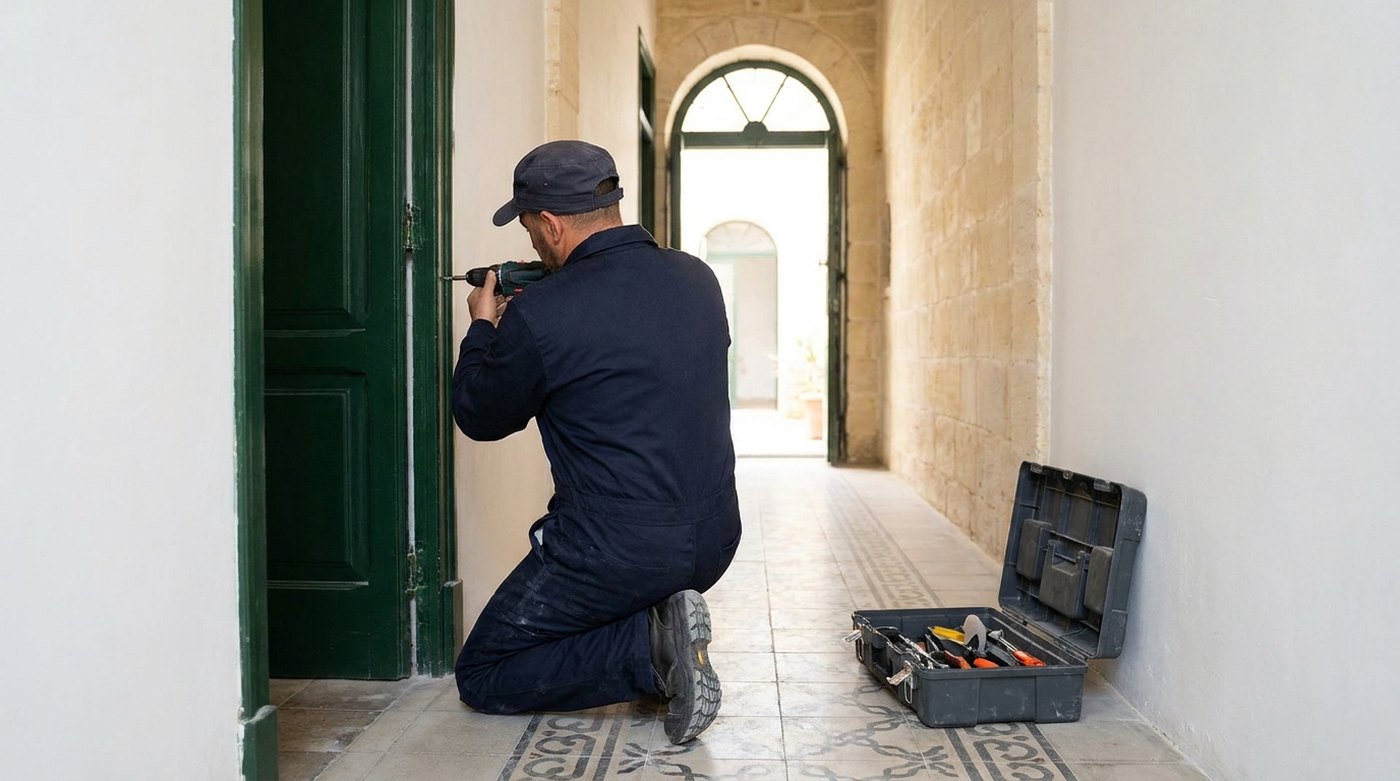
Owning a property in Malta or Gozo while living somewhere else is mostly an access problem. The building is fine; the difficulty is that nobody is standing in it. A leak that would be a towel and a phone call if you were there becomes a ceiling in the flat below because it ran for three weeks. Most of what follows is about shortening that gap.
The three things that actually have to be in place
Someone local who can get in. Not us — we never hold keys. Where a job needs access and you are abroad, the key arrangement is made directly between you and the company attending: you decide who holds it, where it is collected, and whether it goes back afterwards. That is deliberate. A key held by a middleman is a key whose whereabouts you cannot verify from another country.
Photographs before and after. This is the substitute for standing in the room. A job reported back with photos of the state of things on arrival and the state of things on leaving is a job you can judge from abroad. Ask for it as a condition of the work, not as a favour afterwards.
A written note of what is where. Stopcock, water heater, distribution board, tank access, meter numbers, and which neighbour has the lift key. Owners who live here carry this in their heads. You cannot, and neither can someone attending your property for the first time.
The seasonal list, built around how Malta's rain actually falls
Transport Malta gives an average total rainfall of 553.12 mm for the islands, and — more usefully for an owner planning from abroad — says how it is distributed. Almost 51% falls between October and December. January to March accounts for 35%. June to August is barely 2%, and April to September together only 14%.
That distribution is the whole calendar. Two-thirds of the year's water arrives in the autumn and winter half, and the heaviest share lands in a three-month window. The practical consequence is that roof, gutter, downpipe, terrace falls and window seals are a September problem, not a November one. Once the first serious fall has happened you are competing with everyone else who left it.
The same source gives a mean annual wind of 8.8 knots, with January showing the highest variability. Loose terrace furniture, awnings, satellite dishes and anything attached to a parapet are worth securing before the winter rather than after.
Summer is the other half. The dry months are the ones that bring dust, heat and an empty flat with nothing running in it.
| Period | What the climate data says | What it tends to mean for an empty property |
|---|---|---|
| Sep | Before the 51% window opens | Roof, gutters, downpipes, drains, seals |
| Oct–Dec | Almost 51% of annual rainfall | Leaks appear; damp on north walls |
| Jan–Mar | 35% of annual rainfall; January windiest variability | Continued water ingress; wind damage |
| Apr–Sep | 14% of annual rainfall | Dust, heat, AC, stagnant water, pests |
| Jun–Aug | Barely 2% | Nothing washes itself; everything bakes |
Water tank, water heater, AC
Roof tanks and reserve tanks need cleaning, and in a property that stands empty for months the question is not only cleanliness but stagnation. If nobody has run the taps since April, the first person to arrive should run everything through before using it.
Water heaters left switched on in an empty property are heating water nobody uses, every day, for months. Left switched off, they can scale and sulk when switched back on. Decide which you want, and say so in writing to whoever attends. For heater and tank work and for what it costs, see plumber-malta.com. Anything involving the supply to the heater, the distribution board or tripping circuits belongs with electrician-malta.com.
Air conditioning is the thing overseas owners most often discover broken on the day they arrive. Units that sit unused through winter and are then asked to work in August fail in August. Service before the season, not on arrival — see airconditioning-malta.com for pricing. Filters, drainage trays and outdoor units full of dust are the usual culprits, and dust is guaranteed in a period with barely 2% of the year's rain to settle it.
An empty property is also attractive to pests precisely because nothing disturbs it. Drains that have dried out, stored food, and unsealed gaps around pipework are the common routes in. Pricing is at pestcontrol-malta.com. For a clean before you arrive or after a tenant leaves, cleaners-malta.com.
Shell form, and why it matters later
Property in Malta is normally sold in shell form and finished by the buyer. For an overseas owner that has a consequence years later: there is often no single original contractor who knows how the place was put together, and the finishes, services and waterproofing may have been done by several different people at different times. Keep whatever documentation you have, and photograph anything that gets opened up during a repair. It is cheaper than rediscovering it.
Blocks: the administrator and common parts
If you own an apartment, the Condominium Act, Cap. 398 is the frame. It provides for an administrator of the condominium and deals with the common parts of the building. In practice, that means roof, façade, stairwell, lift and shared services are not yours to arrange work on privately — they go through the condominium and its administrator.
This matters most to absent owners in two directions. A leak into your apartment from a common part is a condominium matter, not a job you simply instruct. And a leak out of your apartment into a neighbour's is a problem you will hear about late, from people who could not reach you. Make sure the administrator has a working email address for you and knows you live abroad.
Before any internal works, ask the administrator about working hours, lift protection and access for contractors. Some blocks are strict about all three.
Gozo adds a ferry
Every delivery, every part and every contractor crossing to Gozo adds a ferry to the job. A part that is not on the island is not a same-afternoon part. Assume that any repair needing an ordered component takes longer in Gozo than the same repair in Malta, and say up front that the property is in Gozo so the company quoting knows what it is quoting for.
How this works with us
You tell us the job once. We route it, one job at a time, to a vetted company we choose — a CheckYourTraders member where there is one — and that company reports back with photos. You have one point of contact with us for that job.
What we do not do: plans, subscriptions, contracts, scheduled visits, or promises about attendance and response times. Nobody holds your keys but the people you choose to give them to. Urgent requests are called back from 07:00, or the same day in working hours.
Common questions
- Can you hold a key to my apartment while I'm abroad?
- No. We never hold keys. Where a job needs access and you are not in Malta, the key arrangement is made directly between you and the company attending — you decide who holds it, where it is collected, and whether it is returned after the visit. We are the point of contact for the job, not a key-holder.
- When should I expect water problems in a Maltese property?
- Transport Malta gives average total annual rainfall of 553.12 mm, with almost 51% of it falling between October and December and 35% between January and March. June to August accounts for barely 2%. So roof, gutter, downpipe and terrace drainage issues surface in autumn — the sensible time to look at them is before October, not during the first heavy fall.
- Who do I deal with for work on the roof or façade of my block?
- Those are usually common parts, and the Condominium Act (Cap. 398) provides for an administrator of the condominium. Anything touching common parts needs to go through the condominium rather than being arranged privately by one owner. For work inside your own apartment, you still need to know whether the block has rules on working hours, lift use and access.
- Do you offer a maintenance plan or scheduled visits while I'm away?
- No. There are no plans, subscriptions, contracts or scheduled visits, and we do not promise attendance or response times. It works one job at a time: you tell us the job once, we route it to a vetted company, and it reports back with photos. Urgent requests are called back from 07:00, or the same day in working hours.
What we could not establish
- The sources establish nothing about costs. No rates for key-holding, inspection visits, cleaning before arrivals or any trade are published here — pricing lives on the specialist sites, and nobody publishes a standard 'absent owner' rate for Malta.
- The Condominium Act is cited only for the existence of an administrator and common parts. It does not set out how an absent owner should arrange access, who may let a contractor into a block, or what notice a condominium must give an owner living overseas.
- Transport Malta's figures are climate averages for the islands. They do not tell you how much rain falls on your roof, how a given terrace drains, or in which month a specific building leaks.
- There is no published source here on insurance requirements for a property left unoccupied in Malta, or on what insurers expect in the way of periodic checks.
Sources
- Yachting in Malta (climate section) — Transport Malta · read 2026-10-29
- Condominium Act, Cap. 398 — legislation.mt · read 2026-10-29
Drafted with Claude — claude-opus-5, then read, corrected and approved by Neil Bennett before publication. We do not publish anything a person has not read.
Want this costed properly?
The calculator gives you a figure in a minute. A site visit gives you a fixed price.
Book a free survey